
From the far end of the bayside deck, Museu do Amanhã (Praça Mauá, in Rio's old port district) reads less like a building than a bird pinned to the water, its white louvred fins angled out over the bay and its reflecting pools running clean to the lip of Pier Mauá. Santiago Calatrava finished it in 2015 on a stretch of waterfront that had spent forty years under an elevated motorway and behind freight fencing. In October, with the heat already climbing toward the Rio summer, the hard part is not finding the place. It is picking the right hour and the right day of the week.
What Calatrava put on Pier Mauá
The museum is the showpiece of Porto Maravilha, the port regeneration that pulled down the Perimetral flyover and handed a kilometre of waterfront back to people on foot. That history matters to the visit, because the building was designed to be approached slowly and from a distance, and most of its drama is spent before you ever buy a ticket. The cantilevered roof reaches far out over the plaza; the mobile solar spines along the roof track the sun; water drawn from the bay feeds the pools and the cooling system, then goes back. The structure argues the museum's thesis before the first exhibit does.
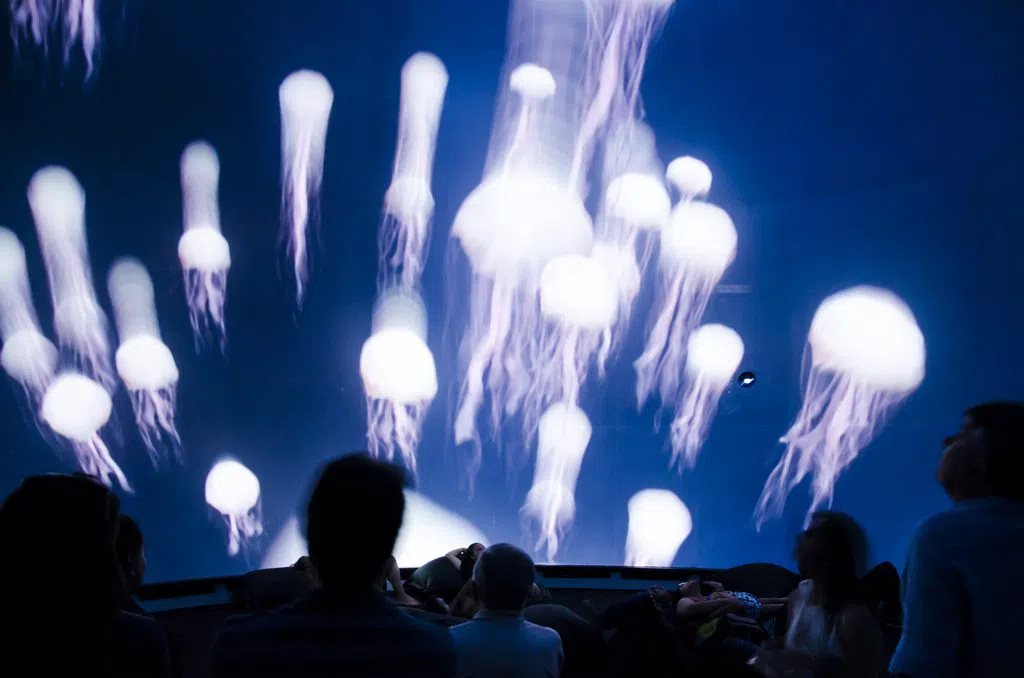
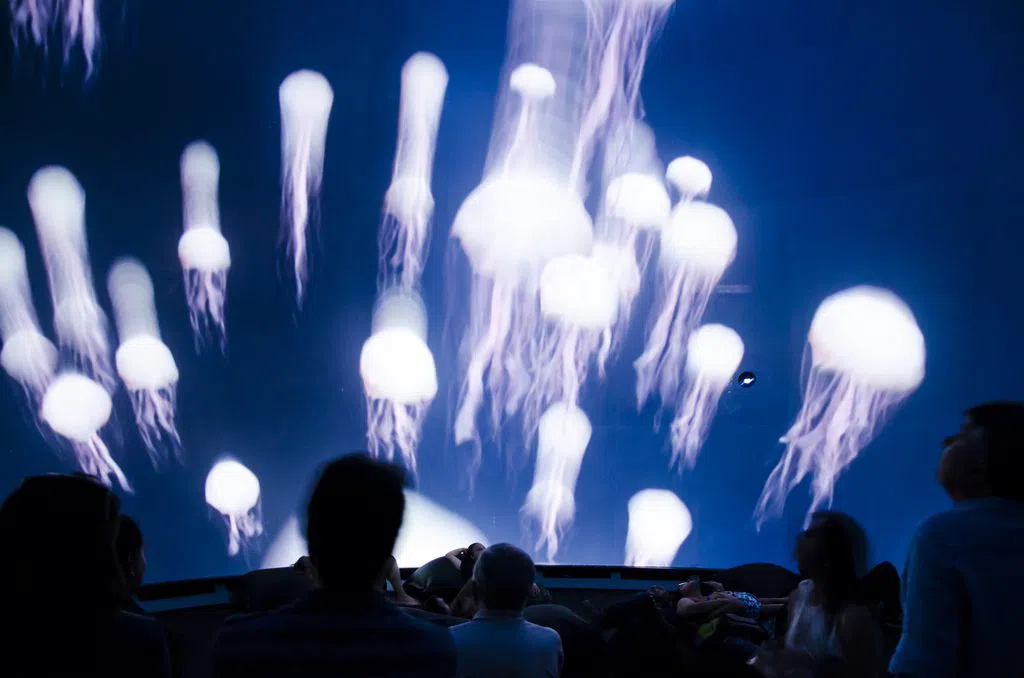
Inside, it is a science museum rather than a collection. There are almost no objects. The permanent exhibition is a scripted sequence of large-format screens, immersive rooms and interactive stations that moves through the origins of the universe, the physical Earth, human impact on it, possible futures, and finally the visitor's own part in all of it. A domed film opens the route; vast cubes handle matter, life and thought; towers of data handle population, energy, consumption and climate. Everything runs in Portuguese and English, and the final rooms ask you to make choices and then show you the aggregate of what everyone else chose that week.
What the visit actually feels like
This is a persuasive, beautifully made argument rather than a neutral display, and some visitors bounce off that. The screens are enormous and the sound design is heavy. Families with children aged roughly eight and up tend to do very well here, because almost everything is touchable and nothing requires reading a label to understand. Visitors who come expecting artefacts, dinosaur bones or a traditional natural-history layout usually leave slightly puzzled about what they paid for.
Allow two to three hours inside, plus a good half hour on the plaza for the building itself, the pools and the view back toward the hills. Rushing it in an hour is possible and pointless; the exhibition is paced like a film and the last third carries the payload. If anyone in the group is prone to motion-sickness in domed projections, the opening film is the one to sit out, and staff will let you rejoin the route afterwards.
The Wednesday mistake and the clock-hour rule
Two scheduling facts cause nearly every wasted journey here. The first: the museum is open Thursday to Tuesday, 10:00 to 18:00, with last entry at 17:00, and it is closed on Wednesdays for maintenance. People arrive on a Wednesday morning, photograph the roof, and go home having seen a car park.
The second: entry runs in timed hourly slots with a capped quota per hour, and your ticket is valid only inside its booked clock hour. A 10:00 ticket admits you between 10:00 and 10:59, not at 11:10 because lunch ran long. There is no penalty once you are through the door, and nobody turns you out at the end of the hour, but arriving late to your own slot means renegotiating at the desk. Groups must all be on the same slot, which is the single thing that trips up families travelling in two cars or parties splitting between a hotel and an apartment. Schools and organised parties are routine business here and there are scheduled mediated visits, so a group booking is a phone call rather than a favour.
If Wednesday is the only day you have in the port, AquaRio (Gamboa, a short walk up the quay) is the standard substitute. South America's largest marine aquarium opens daily from 09:00, takes timed entry slots and group bookings, and absorbs two to three hours on its own. It is also markedly more expensive, at R$160 at the door and R$140 online, with reductions for students, seniors and Rio residents, so treat it as a plan B rather than an equivalent.

Door tickets against booking ahead
The door price is modest for what you get. Full entry is R$40, half price R$20, and the museum is free only on national holidays. The old free-Tuesday scheme ended in April 2025 and plenty of out-of-date advice still repeats it. In October 2026, the national holiday that lands inside the museum's open week is Monday 12 October, which is worth confirming at the box office before you build a morning around it, and worth avoiding if you dislike crowds, because a free day on a capped hourly quota means the early slots go first.
There is also a combined ticket, the Bilhete Único dos Museus, at R$32 for both this museum and its neighbour across the square. You can buy it at either box office, and it is cheaper than the two separate tickets, so buy it first and decide the order afterwards.
Online booking for your preferred hour is the one piece of admin worth doing in advance, particularly for a weekend or a holiday slot, because the hourly cap is real and the popular mid-morning hours fill before the dead afternoon ones. Guided options exist that fold the port in with the famous summits as a single long day out, running seven days a week, and they start from around 173 USD per person. That is a different proposition entirely from a R$40 ticket, and a reasonable one if you want a driver, a guide and no logistics at all. Across the bookable tours in this area there are 6,315 traveller reviews, with the top one rated 5.0 out of 5 from 5,238 of them, so the guided route is well travelled. For most independent visitors, though, the museum is simple enough to do alone that paying for a guide to deliver you to it is hard to justify.
Eating without leaving the building
Praça Mauá at lunchtime is thin on good food, which is the practical argument for Casa do Saulo Museu do Amanhã (inside the museum, Praça Mauá). Chef Saulo Jennings cooks an Amazonian kitchen from the Tapajós here, and the signature pirarucu runs about R$99 with most mains in the R$90 to R$110 band. This is a proper sit-down restaurant, not a museum canteen, and it is the reason to book a late-morning entry slot and eat afterwards rather than hunting for a sandwich on the square.
One wrinkle: the restaurant opens Tuesday to Sunday, 11:00 to 18:00, which does not line up exactly with the museum's Thursday-to-Tuesday week. On any day where the two schedules might diverge, ring ahead. It takes groups and larger tables, but anything over six needs booking in advance, precisely because it sits inside a timed-entry building and cannot flex its floor plan on demand.
Fifty metres across the square
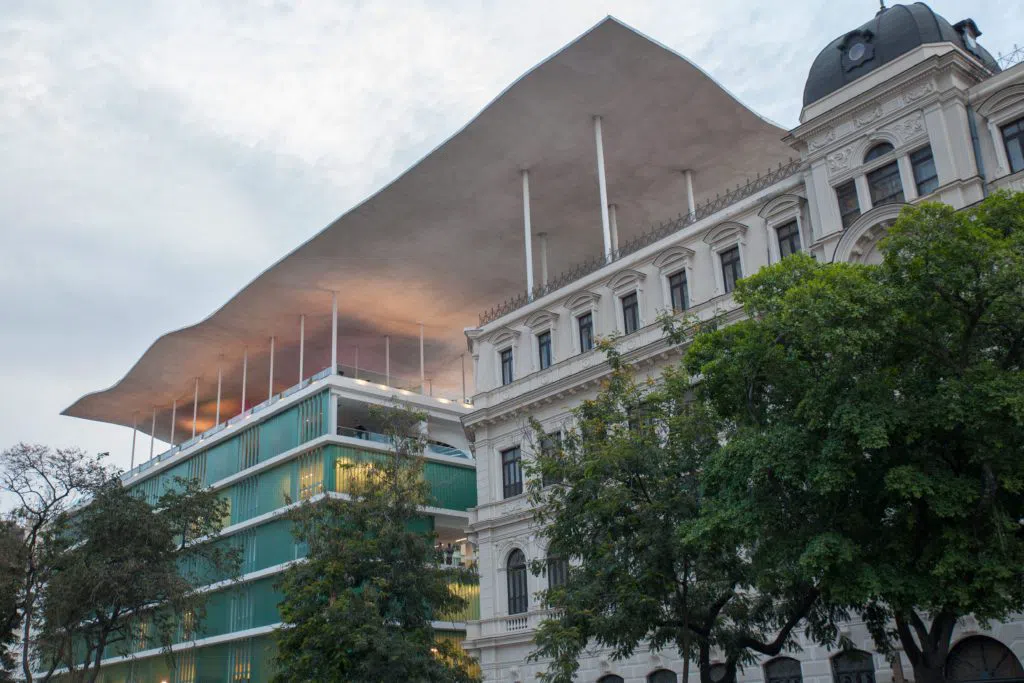
MAR – Museu de Arte do Rio (Praça Mauá) sits directly opposite and is the natural pairing, with the same Thursday-to-Tuesday week, also closed Wednesdays, open 11:00 to 18:00. Entry is R$20 full, R$10 half, free on Tuesdays, and included in the R$32 combo. It shows Rio itself, its art, its migrations and its contradictions, in a converted palace spliced to a former bus terminal under a wave-shaped concrete roof. Guided and mediated visits are available and school groups are standard. Go up to the rooftop: it gives the best free high-angle view of the Museum of Tomorrow's roof you will get without paying for anything.
Fifteen minutes down the waterfront, Centro Cultural Banco do Brasil Rio de Janeiro (Centro) is the other reliable indoor companion and the clean complement to the museum's week, because it opens Wednesday to Monday, 09:00 to 20:00, and closes on Tuesdays. Exhibitions are free, though headline shows use timed tickets that have to be booked per person and fill their slots early. It is also the obvious fallback when an October downpour arrives, which in this month it does, usually in the late afternoon and usually hard.
The walk that makes the museum make sense
Do not take a taxi to the door. Orla Conde (Boulevard Olímpico) (Centro waterfront) is roughly a kilometre of car-free bayside deck from Praça XV to Praça Mauá, and walking it is what turns a building into a place, past the Olympic cauldron, past Candelária, with the bay opening on one side and the rebuilt port on the other. It is free public space with no door policy, and walking groups and free tours use it constantly. In October, walk it early or at golden hour. Mid-afternoon it is shadeless and genuinely punishing.

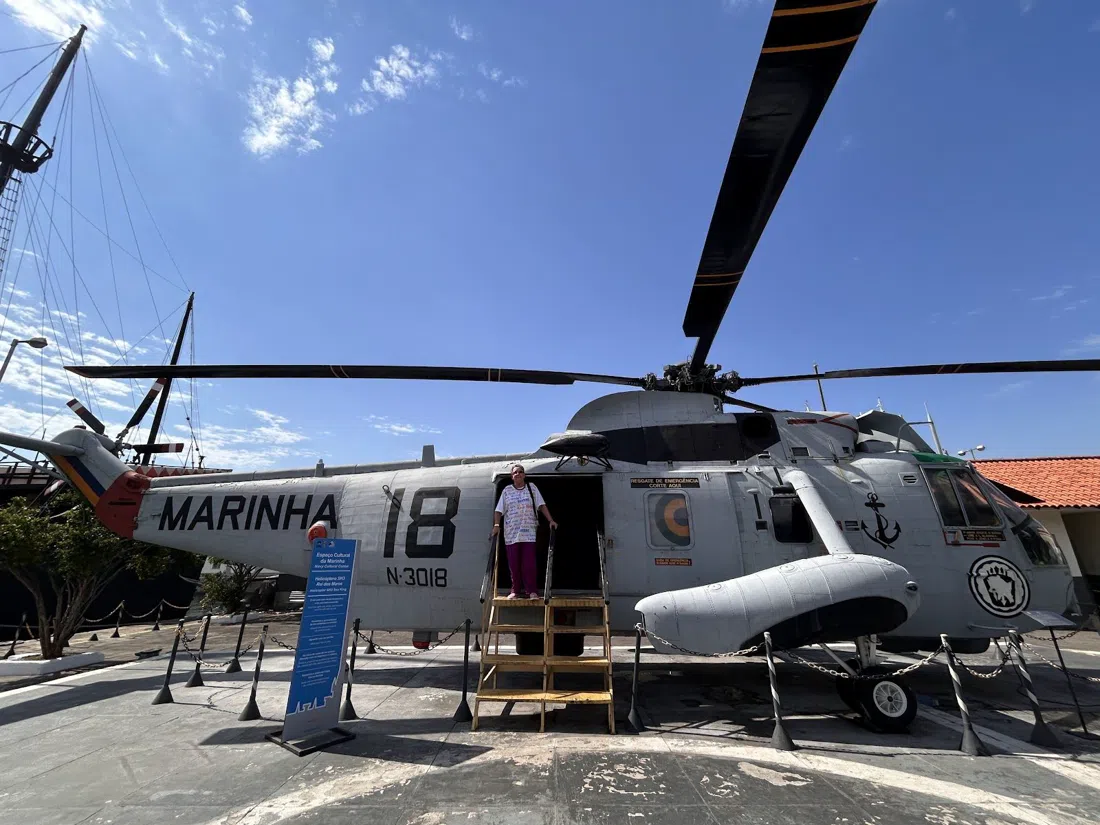
At the Praça XV end, Espaço Cultural da Marinha (Praça XV, Centro) opens Tuesday to Sunday, 11:00 to 17:00, last entry 16:30, at R$20 full and R$10 half, free on Tuesdays except holidays. Its real draw is the boat to Ilha Fiscal, charged separately, which is the only way onto the green castle island in the bay. Crossings run on fixed departures with limited seats and they sell out, so check the month's sailing schedule before you commit a day to it, and book a specific sailing if you are a group.
Along the boulevard behind the museum, Mural Etnias (Todos Somos Um) by Eduardo Kobra (Boulevard Olímpico, Porto Maravilha) covers a long public wall with five faces from five continents. Ten years on from the Olympic summer, the colours have visibly faded and a restoration has been announced but not completed, so expect it duller than the postcards. Street trees block the clean long shot; shoot from the far pavement.
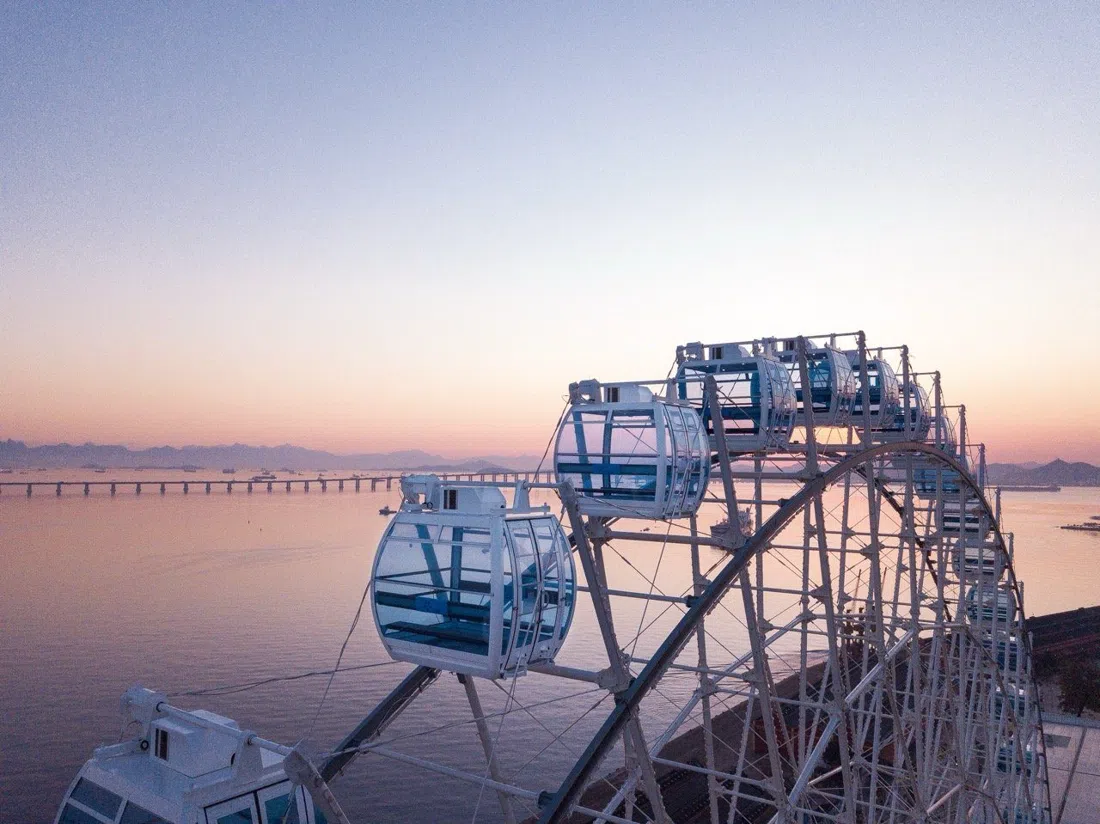
Ten minutes further on, Rio Star (Yup Star Rio) (Gamboa) is the tallest observation wheel in Latin America and the one place that shows you Calatrava's roof from above. Air-conditioned gondolas seat several people, it opens daily 10:00 to 18:00, and it costs R$79 at the gate against R$59 online, R$39 half price, R$29 on the city-resident promotion. Buy online: it is cheaper, it skips the box-office queue, and the tickets stay valid for thirty days, so you can hold one for whichever evening turns out clear.
The counterweight in Little Africa
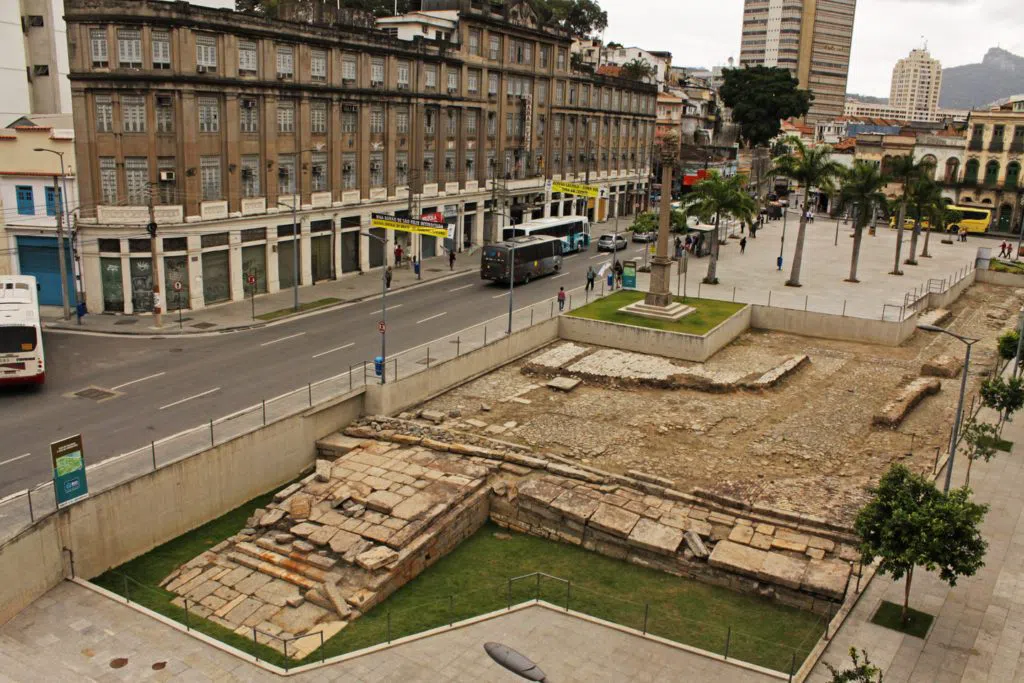
A museum about the future sits ten minutes from the most consequential ground in the Atlantic slave trade, and doing one without the other produces a badly distorted day. Cais do Valongo (Gamboa) is the stone wharf where somewhere between 500,000 and a million enslaved Africans were landed. It was buried, then uncovered in 2011 during the port works, and UNESCO-listed in 2017. It is open air and free, and the African Heritage Circuit runs free guided tours that take groups.
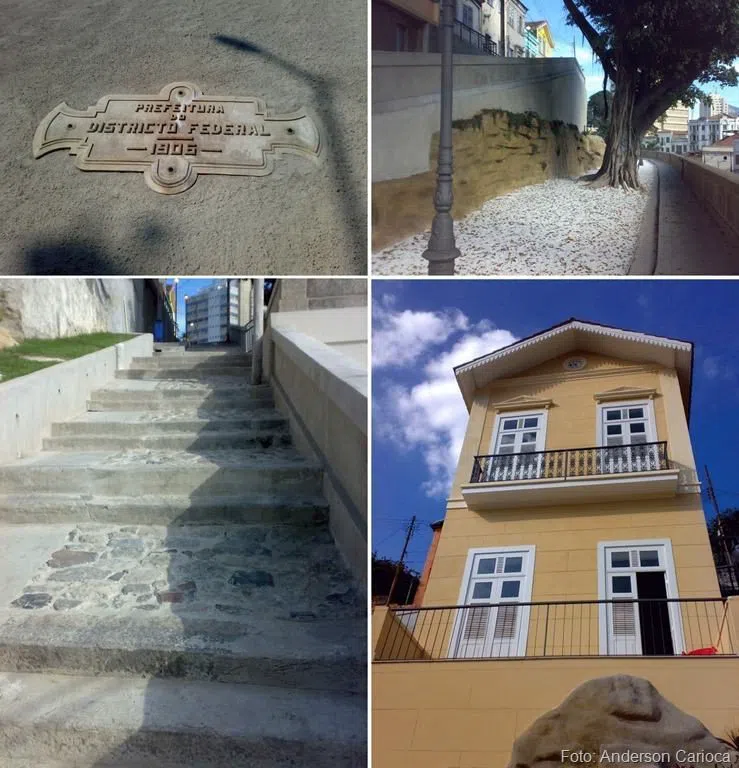
Above the wharf, Jardim Suspenso do Valongo (Gamboa) is a 1,530-square-metre hanging garden on the hillside, open Tuesday to Sunday, 10:00 to 18:00, with the Casa da Guarda displaying archaeological finds from the port digs. It is free, quiet and shaded, and the terraces are tight, so small groups are fine and large parties are not. It is the right place to sit for twenty minutes between the heavy stops.
Instituto de Pesquisa e Memória Pretos Novos (Gamboa) is the hardest and most necessary of them. It stands over the 1769 to 1830 burial ground of the pretos novos, the enslaved who died on arrival, found when a family renovated their own house. Entry is R$20 full, R$10 half, free on Tuesdays for Brazilians. It opens Tuesday to Friday 10:00 to 16:00 and Saturday 10:00 to 12:00, earlier closing than the museum, so go here first and the museum after. The rooms are small, group size is limited, and booked groups must reserve ahead through its visitation page.

The circuit's anchor is Centro Cultural Municipal José Bonifácio (Gamboa), South America's oldest surviving public school building, now holding a permanent show of Porto Maravilha excavation finds and running free workshops and guided visits, including the circuit's free group tours. Its hours shift with municipal holidays; phone rather than turning up.
Where the evening goes
Pedra do Sal (Saúde) is the rock where samba was argued into existence, a short climb from the port. It is open air, free, and there is no door. The signature roda runs on Mondays, roughly 19:00 to midnight, with music Friday to Monday from about 18:00. It gets dense; keep your group together, carry cash only, and buy drinks and food from the street vendors. Pairing a late-afternoon museum slot with a Monday night here is the best single evening the port offers.
For tables and a bit more room, Bafo da Prainha (Largo da Prainha, Saúde) is a Veja Rio best-botequim winner with a City Hall cultural-merit medal, samba most days, and outdoor tables on the square that parties simply merge into. No reservations, so arrive early. Reckon on roughly R$15 to R$60 a head for beer and petiscos. It opens Monday and Tuesday 16:00 to 23:00, Wednesday to Saturday noon to midnight, and Sunday noon to 21:00, twelve minutes uphill from the museum.
Casa Porto (Largo da Prainha, Saúde) is credited with bringing this square back to life and combines a kitchen, bar and gallery in one building. It takes groups across its indoor rooms and the square outside, wants a booking for larger tables at weekends, and runs around R$60 to R$120 a head with drinks. Hours are Tuesday and Wednesday noon to 22:00, Thursday to Saturday noon to 23:00, Sunday noon to 21:00. If drinking on cobbles is not the plan, this is the sit-down version of the same evening.
Best time to go in October
October is the hinge month. The southern spring is already warm and humid, the long afternoon rain is back, and the summer crowds have not fully arrived. That combination favours an early slot. Book 10:00 or 11:00: the building is cool, the plaza photographs well before the sun gets overhead, and you come out into lunch rather than into the worst of the heat. The 11:00 slot also sets up the restaurant inside neatly.
The alternative is a 15:00 or 16:00 entry, which gives you the quietest galleries of the day and puts you back on the waterfront for golden hour and the walk west along the deck. Avoid the middle of the day for anything outdoors, whether the boulevard, the mural or the wharf. There is no shade worth the name on that promenade.
By day of the week, Thursday and Friday are the calmest inside. Weekends bring Rio's own families, which is pleasant but busier on every hourly slot. Monday is a good day only if you want the samba roda in the evening; remember the memorial museum is shut on Mondays. Wednesday is not a day for this museum at all.
Is it worth it
Yes, with a caveat about expectations. For R$40, or R$32 with the art museum folded in, you get one of the most ambitious buildings on the continent and a two-hour exhibition that is well made, properly researched and unapologetically arguing a case. That is good value by any standard, and considerably better value than the price of the all-day guided alternative if you are willing to arrange a slot yourself.
It suits curious adults, couples with a half day in the centre, and families with school-age children who want to press things. It suits groups well, provided someone books one slot for everyone. It does not suit visitors who want objects and collections, anyone short on patience for screens, or a traveller with a single Rio day who has not yet seen the bay from a height. And it only really works as part of the port: the museum alone is a nice ninety minutes, while the museum plus the wharf, the hanging garden and the memorial is a day you will remember.
Practical notes
Getting there. The VLT light rail stops at Praça Mauá, essentially outside the door, and connects to the central metro stations and the domestic airport. Walking from the Praça XV end of the waterfront takes about twenty minutes along the deck. Rideshare is cheap and plentiful, and is the sensible way back from the port in the evening rather than walking out through empty blocks after dark.
Cash and cards. Cards and Pix work at every museum box office, the restaurants and the wheel. Pedra do Sal is cash only and so are the street vendors around the Largo, so carry small notes for the evening.
Timing. Pre-book one hourly slot for the whole party; arrive inside your clock hour; allow two to three hours plus thirty minutes outside. Check the Wednesday closure against your itinerary before anything else.
Budget per person. Museum R$40, or R$32 for the two-museum combined ticket. Memorial museum R$20. Naval centre R$20 plus the island crossing. Observation wheel R$59 online. Aquarium R$140 online if you need the Wednesday substitute. Lunch inside the museum R$90 to R$110; botequim evening R$15 to R$60. Everything along the waterfront, the mural, the wharf, the hanging garden and the cultural centre is free.
Where to stay. The port is a daytime district with little accommodation of its own; most visitors base themselves in the centre or on the beaches and come in by light rail. Compare options with the Rio De Janeiro hotel search, and for the rest of the city read the Rio De Janeiro guide.